Breaking camp involves more than packing chairs and disconnecting hookups. Here’s how a repeatable RV departure checklist can help prevent missed steps.
You’re packed. The campsite is cleaned up. The truck is running—or the motorhome is ready to roll—and everyone is waiting on you.
Then comes that familiar question:
“Did we forget anything?”
You look around one more time. The awning is in. The chairs are packed. The slides look closed. You’re pretty sure the hookups are disconnected.
Pretty sure.
That’s the problem.
Breaking camp involves a lot of small steps, and many of them matter far more than remembering a folding chair. Missing the wrong one can damage the RV, destroy equipment, create a safety problem or bring the entire trip to a very expensive stop.
A dependable RV departure checklist isn’t about being overly cautious. It’s about replacing memory with a repeatable system.
Memory Is Not a Departure System
Most RV owners develop some kind of routine over time. You work your way around the camper, put things away and mentally check items off as you go.
That system works—until something interrupts it.
Someone asks a question. A neighbor stops to talk. The dog needs attention. You go back inside for one thing and start doing something else. Two people handle different parts of the setup and each assumes the other completed a certain task.
That’s how steps get missed.
The more familiar the routine becomes, the easier it is to go through the motions without consciously verifying every item. Experienced RV owners aren’t immune to mistakes. In some cases, familiarity creates more confidence in memory than memory deserves.
A good checklist gives every important step a visible status. It shows what has been completed and, just as importantly, what has not.
Towable RVs and Motorhomes Need Different Checks
A travel trailer or fifth wheel does not have the same departure process as a motorhome.
Towable RV owners have hitching equipment, safety connections and tow-vehicle considerations. Motorhome owners have a powered chassis and may also be preparing a towed vehicle. The basic goal is the same, but the actual checklist should match the type of RV being used.
Towable Campers, Travel Trailers and Fifth Wheels
A towable-RV departure routine may include checking items such as:
- Hitch or fifth-wheel connection
- Safety chains where applicable
- Breakaway cable
- Electrical connection
- Tongue jack or landing gear
- Stabilizers and leveling equipment
- Wheel chocks
- Steps, handrails and exterior compartments
- Slides and awnings
- Water, sewer and electrical hookups
- Propane and appliance settings
- Windows, vents and roof-mounted equipment
- Interior cabinets, doors and loose items
- Tires, wheels and exterior lights
The exact list will depend on the trailer, hitch system, equipment and manufacturer’s instructions. The point is not to memorize a universal list—it’s to build a consistent process for your RV.
Motorhomes
A motorhome checklist may include many of the same living-area and campsite items, but the vehicle side of the process is different.
Common categories can include:
- Leveling jacks
- Slides and awnings
- Shore power, water and sewer connections
- Steps and handrails
- Exterior storage compartments
- Antennas and roof-mounted accessories
- Interior cabinets, doors and loose items
- Driver-area preparation
- Tires, mirrors, lights and visible fluid leaks
- Towed-vehicle connections, when applicable
Again, every motorhome is different. Manufacturer instructions and a proper pre-trip inspection always come first.
The Walkaround Still Matters
A checklist should never replace a physical walkaround.
Before leaving, walk completely around the RV and actually look at it from top to bottom. Don’t just glance in its direction while carrying the last bag to the truck.
Look underneath it. Look above it. Check both sides. Step far enough away to see whether an awning, vent, antenna, slide, compartment door or piece of equipment looks out of place.
If you are towing, inspect the connection rather than assuming it is correct because you completed the same routine yesterday. If someone else helped, verify the critical items yourself before moving.
The goal isn’t to distrust everyone. It’s to make sure responsibility doesn’t disappear between two people who each thought the other person handled it.
Why Phone Notes Don’t Always Work
A checklist saved on your phone is better than having no checklist at all. But phones aren’t always the most practical tool while breaking camp.
Your hands may be dirty or wet. The screen locks. Sunlight makes it hard to read. Notifications interrupt you. Someone else may be completing part of the routine while the checklist is sitting in your pocket.
Paper lists have their own problems. They get misplaced, damaged, buried inside the RV or marked up until nobody knows whether the checkmarks are from today or the last trip.
The best checklist is the one you can see, understand and reset easily.
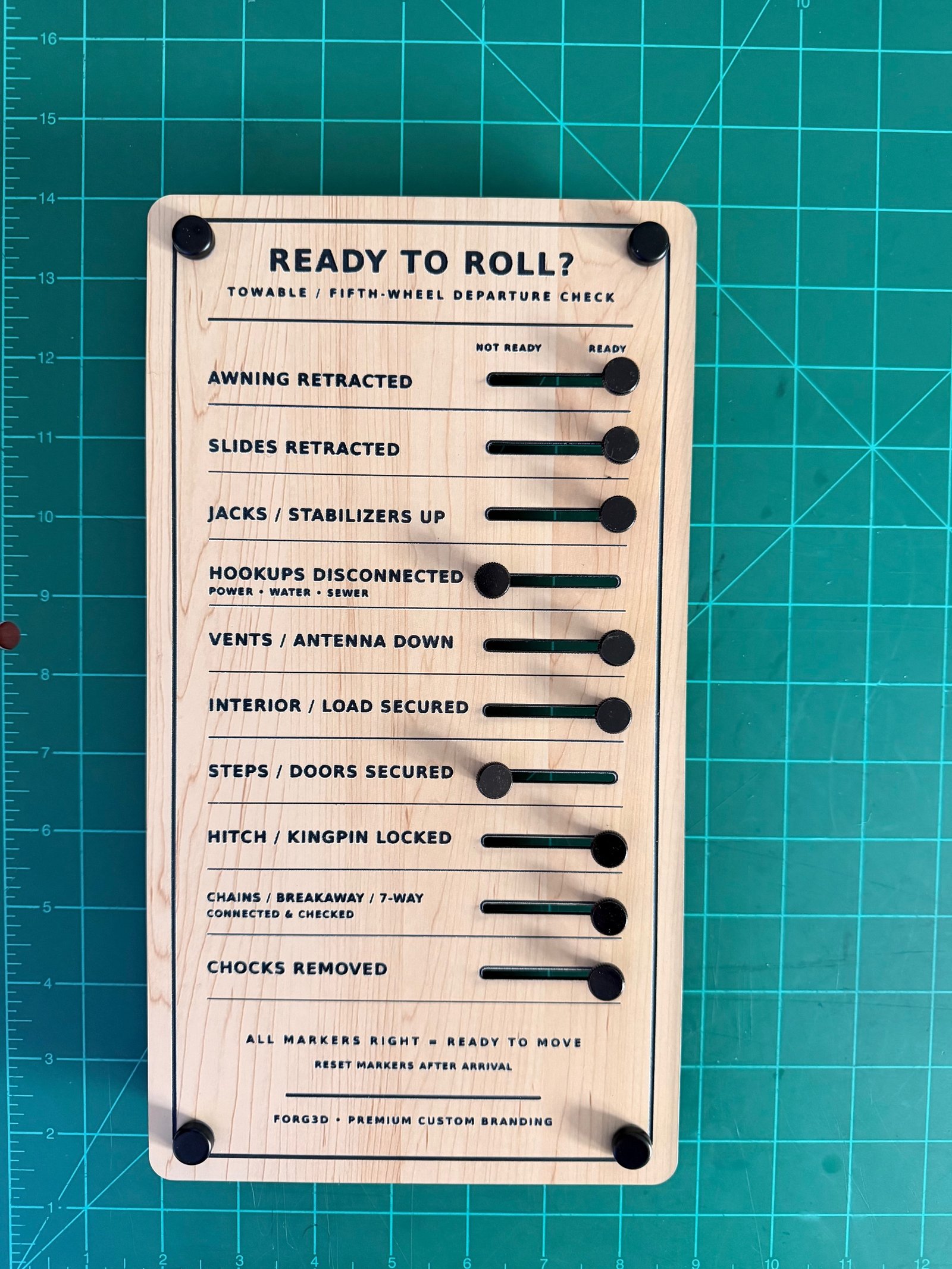
That was the thinking behind our RV Ready-to-Roll Departure Checklist Board.
A Physical Checklist You Can Reset Every Trip
We designed the Ready-to-Roll board around a simple idea: every departure item should have an obvious visual status.
Each checklist item has a sliding toggle. Start with every toggle positioned to the left. As each task is physically completed and verified, move its toggle to the right.
If one toggle is still sitting on the left, you immediately know the departure routine is not finished.
When you arrive at your destination and finish setting up, reset the toggles to the left. The board is then ready for the next departure.
There’s no app to open, battery to charge, paper to replace or old set of checkmarks to interpret.
It’s deliberately simple because simple systems are easier to use consistently.
Built for Towable RVs and Motorhomes
Because the departure process differs between RV types, we offer two board layouts:
- Towable Camper / Travel Trailer / Fifth Wheel
- Motorhome
Customers can also choose from several engraved acrylic finishes, including stainless-look, gold-look, cashew wood-look, gloss black and white.
Each board measures approximately 6.5 inches wide by 11.75 inches tall. The engraved 1/16-inch two-tone acrylic face is attached to a rigid 1/8-inch black acrylic backing, creating a durable board designed for repeated use.
The board is compact enough to keep inside the RV where it stays visible without taking over the wall.
A Checklist Only Works If You Actually Use It
No checklist can prevent every possible mistake. It also cannot account for every RV, accessory, modification or campsite situation.
What it can do is turn an inconsistent memory-based routine into a visible process that is easier to repeat.
The key is using it the same way every time:
- Reset every toggle after arriving and setting up.
- Move a toggle only after that task is actually completed.
- Perform a complete physical walkaround before departure.
- Follow the RV manufacturer’s procedures and safety instructions.
- Update your personal routine whenever equipment or travel habits change.
The board is a supplemental reminder and organization tool—not a replacement for the owner’s manual, maintenance requirements, safety procedures or a proper pre-trip inspection.
The Best Departure Is the Uneventful One
Nobody buys an RV because they’re excited about packing hoses, raising jacks or checking compartment doors.
You buy one for the places it can take you.
A consistent departure routine helps you spend less time wondering what was forgotten and more time looking forward to where you’re going next.
Because the best moment after leaving a campsite isn’t remembering something twenty miles down the road.
It’s knowing you checked before you pulled out.
Explore the FORG3D RV Ready-to-Roll Departure Checklist Board for motorhomes, travel trailers and fifth wheels, or contact us about a custom RV project.
Related Services: RV Branding · More from FORG3D Shop Talk